
Overview
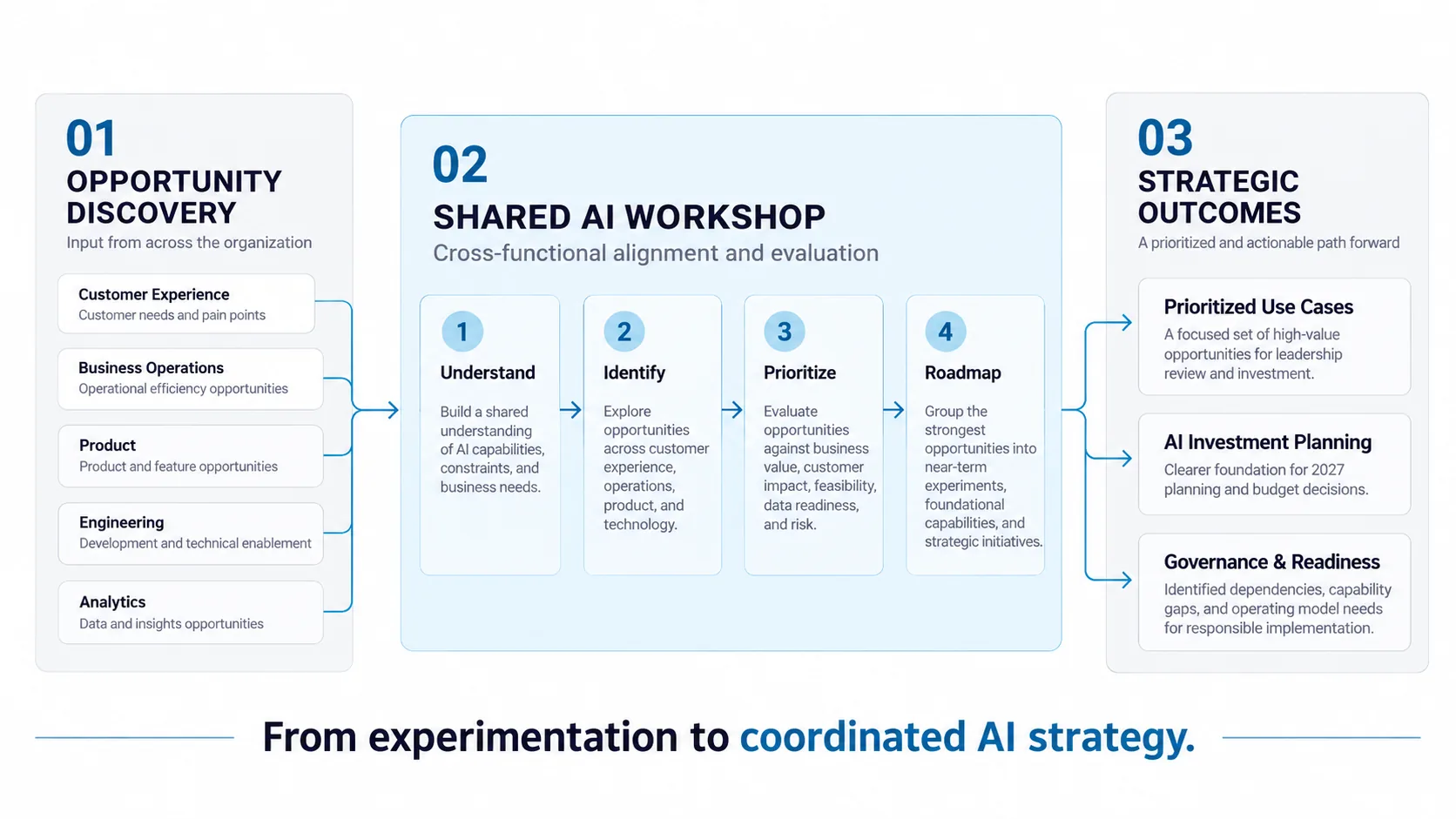
AI was becoming a priority across our Digital Commerce organization, but identifying where it could deliver meaningful business value was a different challenge.
Teams were exploring opportunities independently, often approaching AI from different perspectives. Some focused on improving customer experiences, while others saw opportunities to accelerate internal workflows, automate repetitive processes, or improve development efficiency.
What we lacked was a structured way to evaluate those ideas collectively and determine which opportunities deserved investment.
I led the planning and facilitation of a cross-functional AI workshop designed to move our organization beyond experimentation and toward a practical, prioritized AI strategy.
The objective was straightforward: identify meaningful opportunities, establish organizational alignment, and provide leadership with a defensible foundation for 2027 AI investment decisions.
The challenge
The challenge wasn’t generating AI ideas. We already had plenty of them.
The challenge was determining which ideas addressed meaningful problems, could realistically be implemented, and aligned with our broader Digital Commerce objectives.
Different teams had different priorities, levels of AI understanding, and assumptions about implementation complexity.
Without a shared evaluation framework, we risked investing in disconnected experiments without establishing the data, governance, and technical foundations required to scale successful solutions.
We also needed to understand how AI initiatives would move through existing organizational processes, including approval requirements, ownership, and the emerging role of AI governance.
AI adoption needed to become a coordinated product-planning exercise rather than a collection of independent technology experiments.
My role
I co-owned the workshop strategy, planning, and facilitation, working with leadership to establish clear objectives and identify the right cross-functional participants.
My responsibilities included designing the agenda, structuring collaborative exercises, defining prioritization criteria, and guiding discussions from broad AI concepts toward actionable opportunities.
I also helped consolidate the workshop findings into a clearer set of priorities, dependencies, and potential next steps.
Rather than organizing the session around specific AI tools, I structured it around business problems, customer needs, and organizational readiness.
This distinction was important because the value of an AI initiative should be determined by the problem it solves, not the technology it introduces.
The workshop framework
I structured the workshop into four stages that progressively moved participants from exploration toward execution planning.
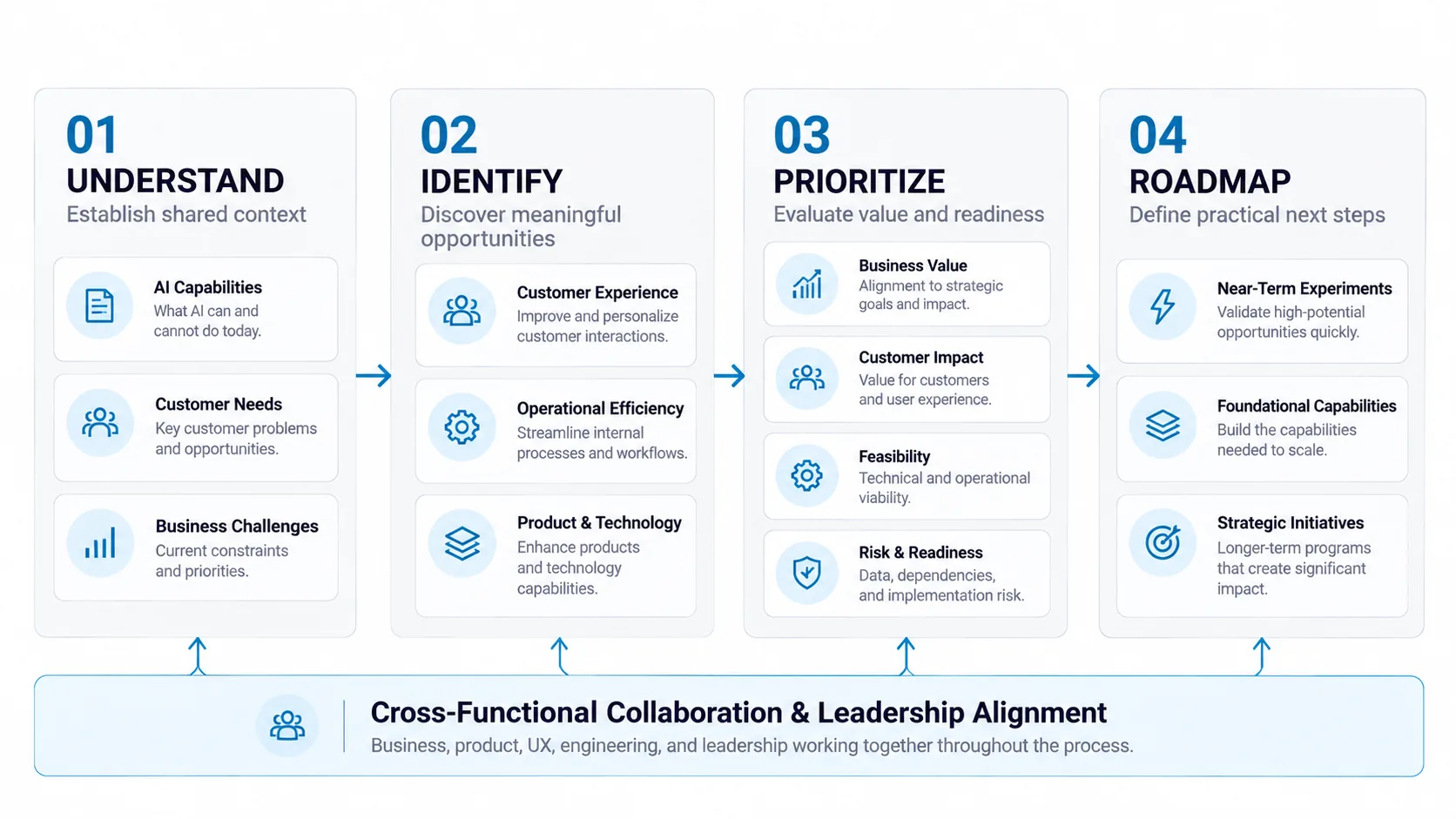
Stage 01
Understand
We established a common understanding of AI capabilities, limitations, business challenges, and customer needs.
This created a foundation for productive discussions across participants with different technical backgrounds and organizational responsibilities.
Stage 02
Identify
Participants explored opportunities across customer experience, product discovery, employee workflows, content operations, analytics, and development processes.
The goal was to identify problems where AI could meaningfully improve an existing experience or operational capability.
Stage 03
Prioritize
We evaluated opportunities against business value, customer impact, technical feasibility, data readiness, implementation effort, and risk. These were presented to a leadership board in a ten-minute, “shark tank”-like pitch.
This helped distinguish promising initiatives from ideas that required additional investigation or foundational investment.
Stage 04
Roadmap
We organized the strongest opportunities into near-term experiments, foundational capabilities, and longer-term strategic initiatives. This was accomplished by creating a ranking sheet that leadership could use during the presentation. At the end, the sheet auto-calculated the results and allowed us to address the top priorities.
This established an initial framework for determining what could be tested, what needed organizational preparation, and what should inform future investment planning.
From opportunities to investment priorities
The workshop brought together more than ten leaders and stakeholders and generated 18 potential AI opportunities.
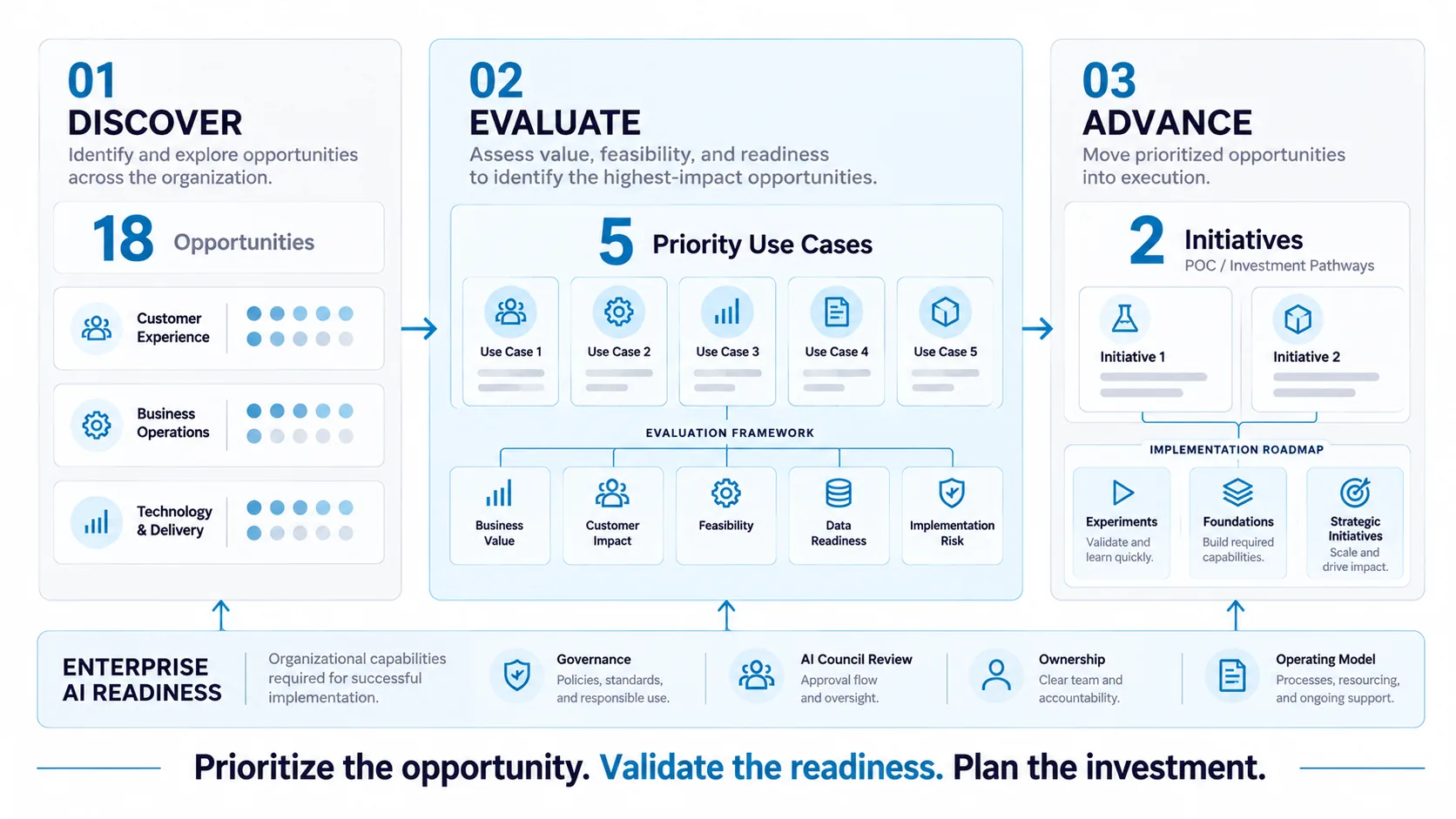
Through structured evaluation, we narrowed those opportunities to five priority use cases.
Two initiatives advanced toward proof-of-concept or funded project pathways, creating opportunities to validate assumptions before committing to broader implementation.
More importantly, the workshop helped establish a clearer connection between AI opportunities and the investment decisions leadership would need to consider for 2027.
It also exposed organizational gaps that were not immediately visible when discussing individual AI solutions.
These included questions around governance, AI Council approval processes, implementation ownership, and the operating-model changes needed to support enterprise AI adoption.
Those findings became an important part of the workshop’s value.
Leadership impact
The workshop changed how we approached AI planning.
Instead of asking where AI could be introduced, we began evaluating which problems justified investment and what capabilities were necessary to support implementation.
We established a shared framework for evaluating opportunities, improved alignment between business and technology stakeholders, and created a more structured foundation for future AI planning.
The experience reinforced an important leadership principle:
The workshop was an initial step toward that operating model.
Confidentiality note: This case study presents a generalized version of the workshop framework and decision-making process. Proprietary use cases, internal documentation, detailed financial information, and identifiable implementation details have been excluded. The numerical workshop outputs reflect the figures supplied for this case study.