
Overview
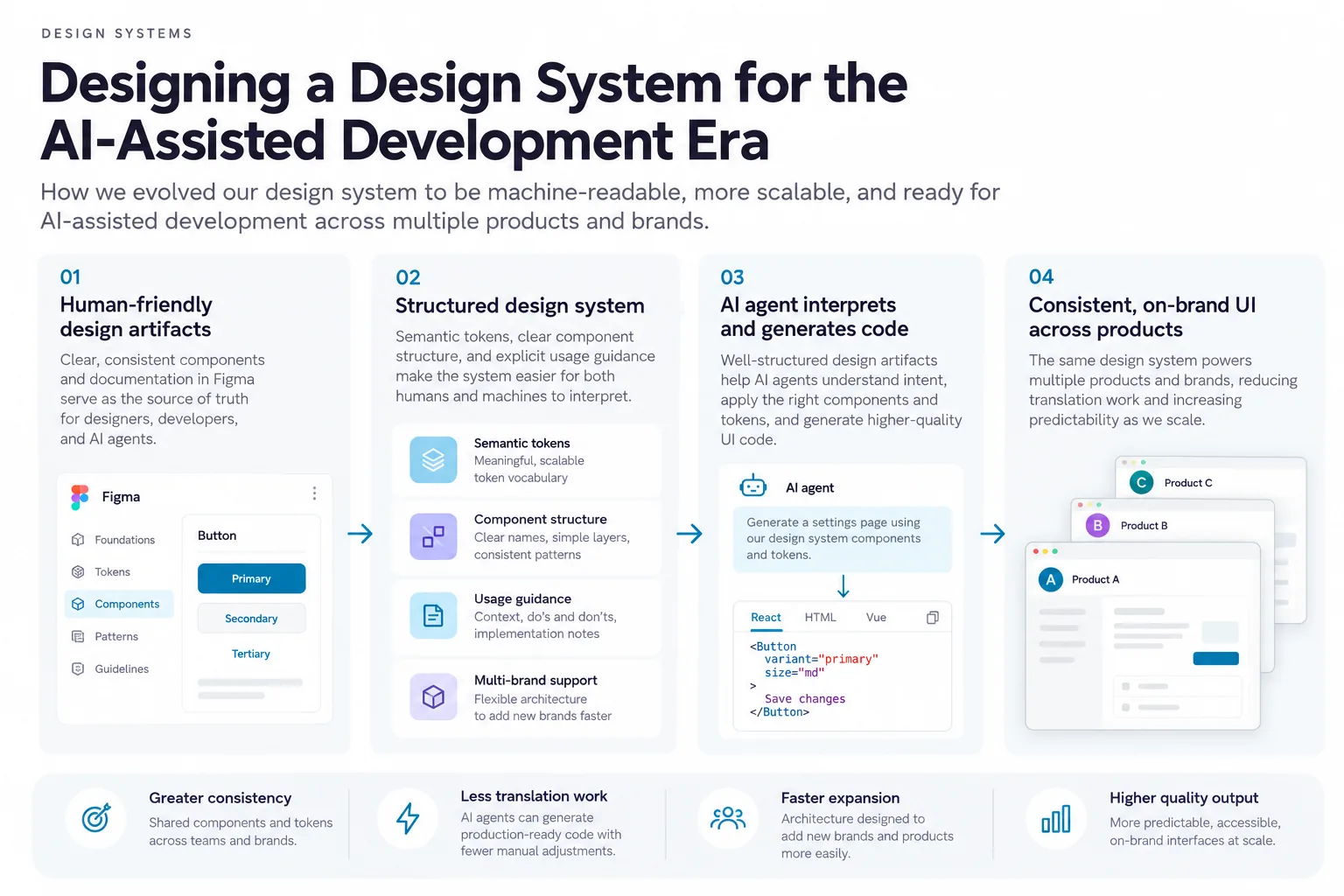
In late 2025, I began guiding our design system team toward a new question: what changes when design files are no longer consumed only by designers and developers, but also by AI-assisted development tools?
The existing system was effective for human teams working within a defined digital commerce environment, but the next version needed to support a broader role. It still had to produce on-brand, accessible experiences that reflected the intended customer journey, while also creating enough structure and context for AI tools to interpret design intent and help generate implementation-ready interface code across additional products and brands.
The challenge
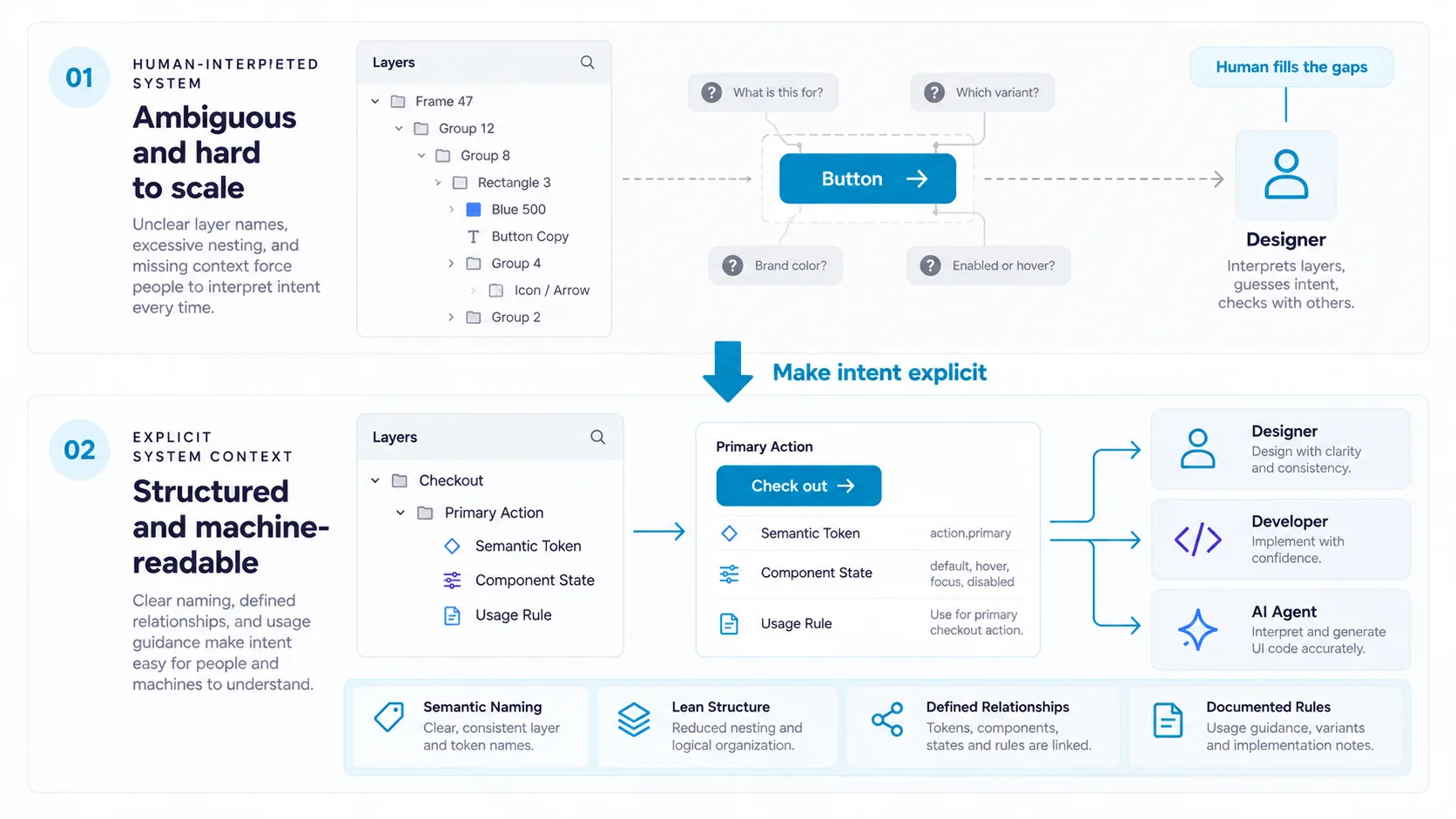
Traditional design systems are usually optimized for human browsing. UX Designers can interpret ambiguous layer names, understand visual relationships, and fill gaps in documentation through experience. AI agents cannot reliably make the same assumptions within design tools like Figma.
The team's research identified several areas that could create ambiguity for machine-assisted workflows: inconsistent semantic structure, excessive layer nesting, limited token depth, and incomplete relationships between design decisions, component behavior, and lack of implementation guidance.
The organizational challenge was equally important. During the research phase, the product owner left the company. I needed to establish new product leadership without losing the original direction of the initiative. The replacement needed to understand that the goal was not simply to modernize a component library. We were building a stronger system foundation for both human teams and AI-assisted delivery.
My role
I set the strategic direction for cleaner, more interpretable design artifacts and selected a new lead who could continue advancing the work. I partnered with the design system team on how system knowledge should be structured so designers, developers, and AI agents could work from the same source of truth.
At the delivery level, I remained involved through sprint briefings and design reviews, providing guidance on priorities, system direction, and organizational constraints.
In parallel, I began socializing the initiative with leadership to build support for expanding the system beyond its original product area and to secure the budget and engineering capacity required for an agentic development proof of concept.
Key decisions
Decision 01
Expand the token architecture
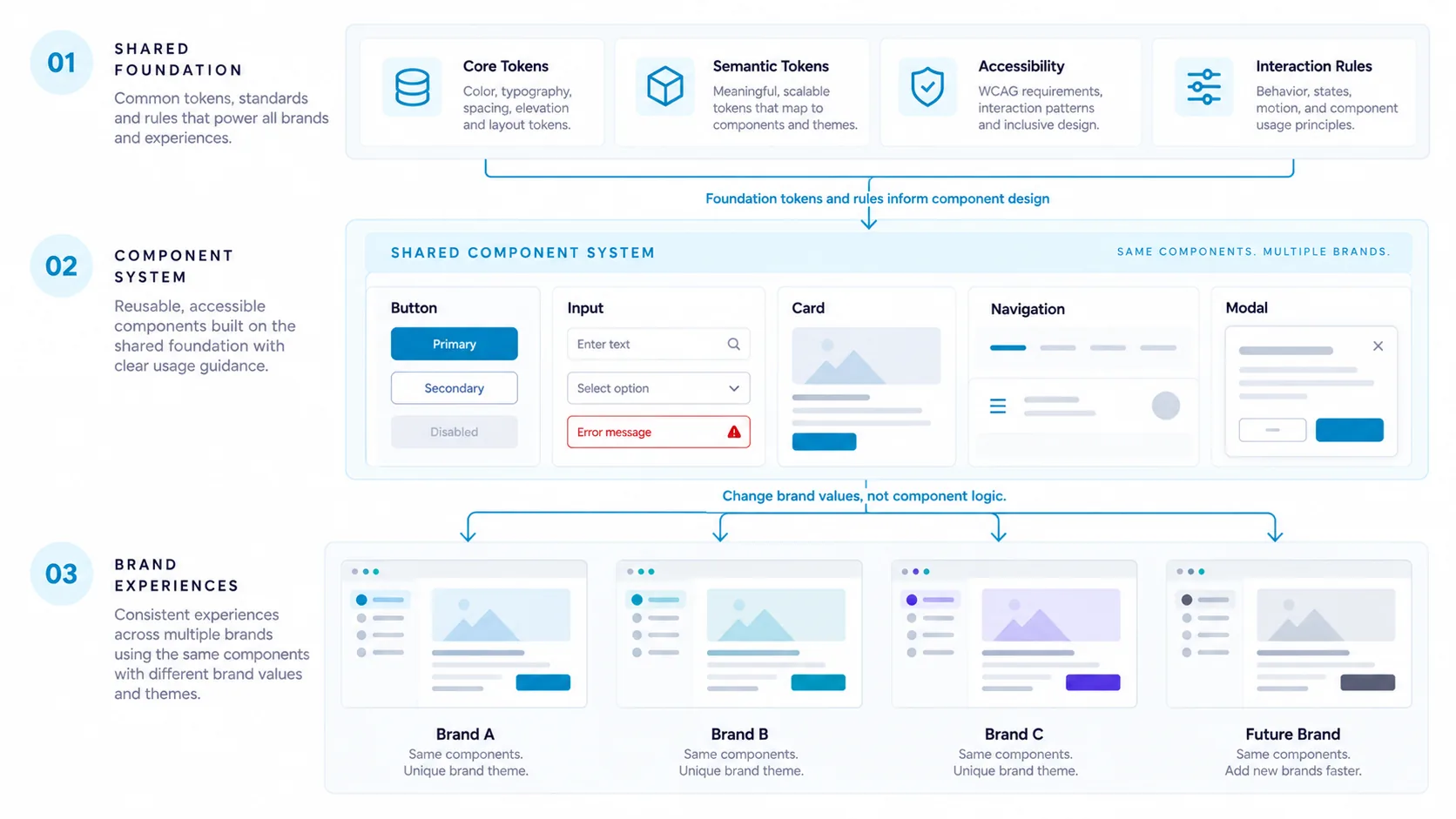
The existing system did not contain enough semantic depth to support the number of brands, themes, and implementation contexts we expected the organization to require.
Semantic depth for more brands, themes, and implementation contexts.
Decision 02
Build on an established structure
The team evaluated an established open-source Figma design system structure, using Flowbite as a reference for improving organization and consistency rather than starting from an entirely custom structure.
A proven reference for organization and consistency, not a custom starting point.
Decision 03
Make usage and intent explicit
We emphasized explicit component usage guidance, clearer naming, and stronger relationships between design artifacts and Storybook documentation. A senior designer also helped define a token vocabulary that could map more predictably into implementation tooling.
A token vocabulary that maps predictably into implementation tooling.
The solution
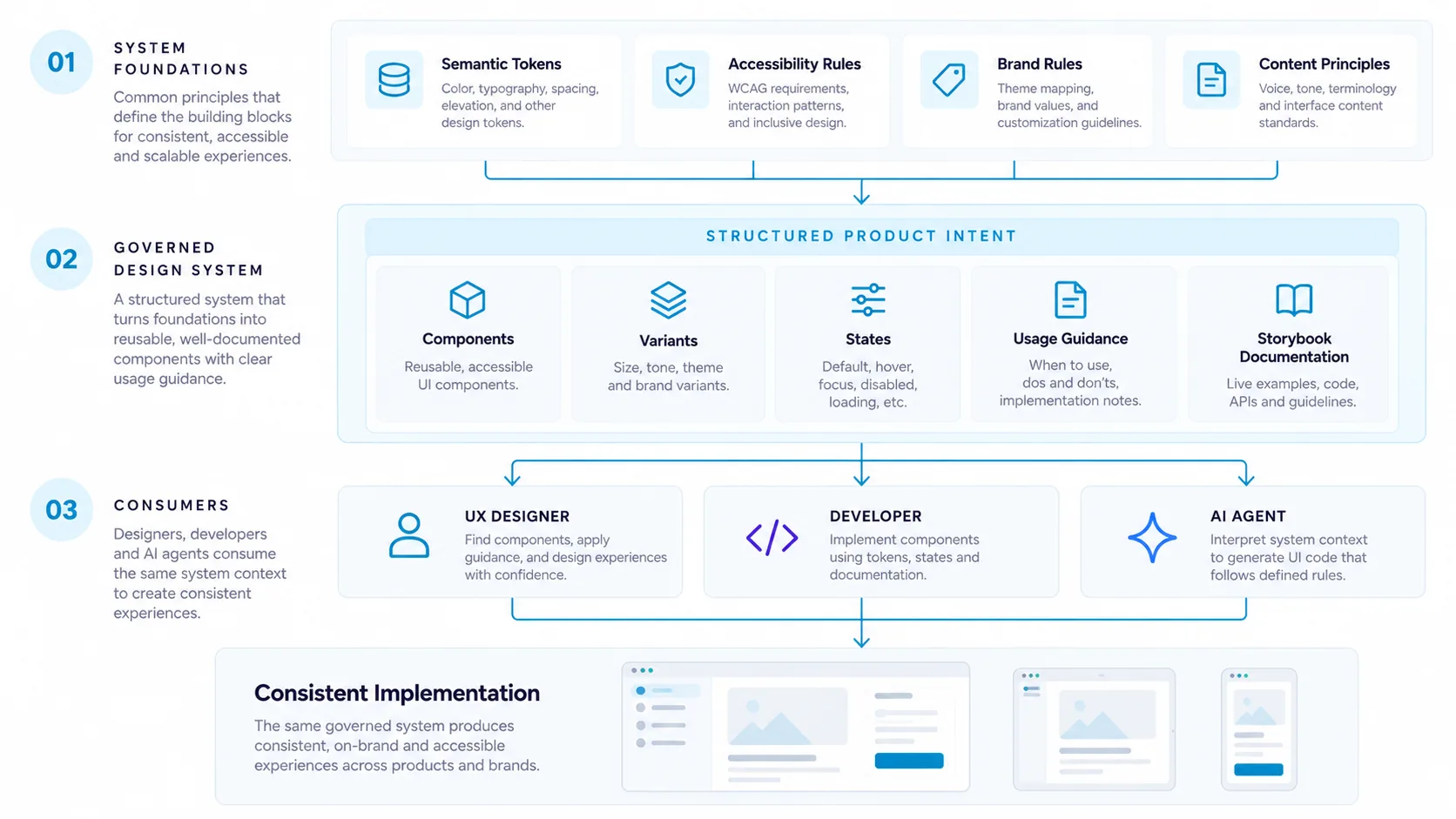
The team began restructuring design assets around the new system architecture, defining the roadmap for rebuilding and coding components, and documenting the constraints required to use those components correctly.
The goal was for a UX designer, developer, or AI-assisted coding agent to interpret the same component rules, states, tokens, and usage guidance with less translation between disciplines.
The architecture also needed to support multiple internal brands without duplicating the system. The team developed a more scalable approach for introducing brand-specific token values while preserving a shared underlying component model, reducing the effort required to introduce additional brands over time.
Impact and current status
The work remains in the proof-of-concept phase, so I would not characterize the program as a completed production transformation yet.
The early result is a design system that is becoming more structured, more semantically explicit, and better positioned for AI-assisted implementation. The team has progressed to the point where generated interface code can now be evaluated against production requirements rather than treated only as an experiment.
The larger outcome is architectural: the design system is evolving from a library people reference into a structured source of product intent that both people and machines can consume.
Because of confidentiality requirements, this case study cannot show the actual design system, brand identities, or proprietary implementation details. Impact metrics have also been omitted, so the examples focus on the strategy, architecture, operating model, and design decisions behind the work.