
Overview
Most portfolios are passive. They document previous work and depend on someone intentionally visiting the site to discover it.
I wanted to create something different.
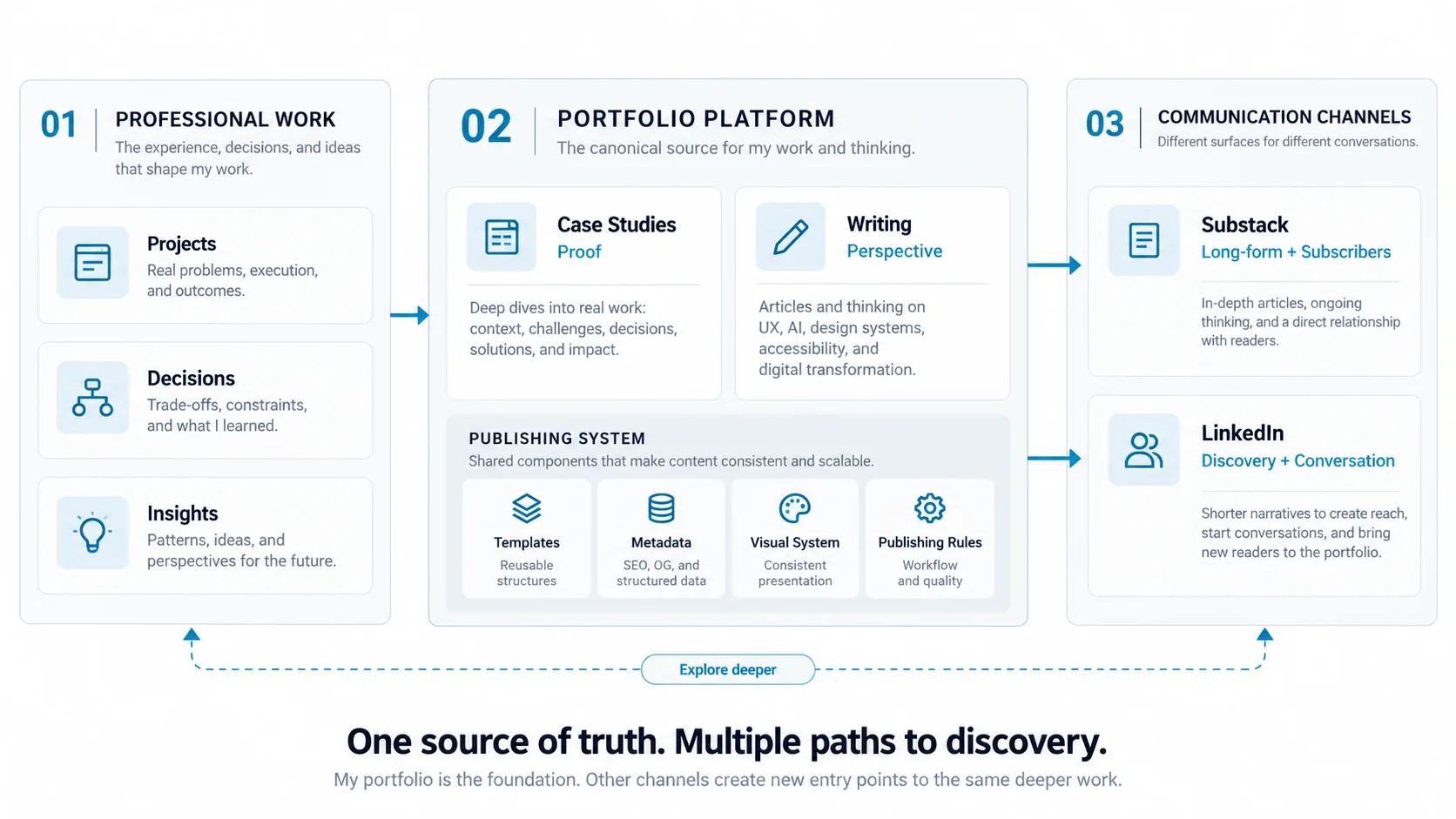
I redesigned my portfolio as the central layer of a broader professional communication system. The website remains the canonical source for my work, but individual projects and ideas can extend into channels where professional conversations are already happening.
The model connects three primary surfaces:
Channel model (Portfolio , then Substack , then LinkedIn)
Each has a specific role. The portfolio provides depth and evidence. Substack supports long-form thinking and a direct subscriber relationship. LinkedIn creates discovery, reach, and professional conversation.
The objective was to move from a static collection of projects toward a system for continuously communicating how I approach UX, AI, design systems, accessibility, and digital transformation.
The longer-term goal is even broader: establish the portfolio as a personal digital platform that can eventually connect future AI agents, knowledge, projects, and professional activity into one system.
The challenge
Traditional portfolios create a discovery problem.
A recruiter, executive, or peer must already know the portfolio exists, navigate to it, select a project, and invest enough time to understand the work. Strong case studies can remain largely invisible outside that narrow discovery path.
Social platforms solve part of the problem but create another. Posts are temporary and fragmented. Important ideas disappear into feeds, and the platform controls how content is distributed and rediscovered.
I needed an architecture that supported both durability and distribution.
My role
I treated the redesign as both a product problem and a content-system problem.
I defined the information architecture, visual language, case-study framework, article structure, metadata strategy, publishing workflow, and relationship between the portfolio, Substack, and LinkedIn. I also designed and developed the portfolio itself.
The underlying principle was reuse.
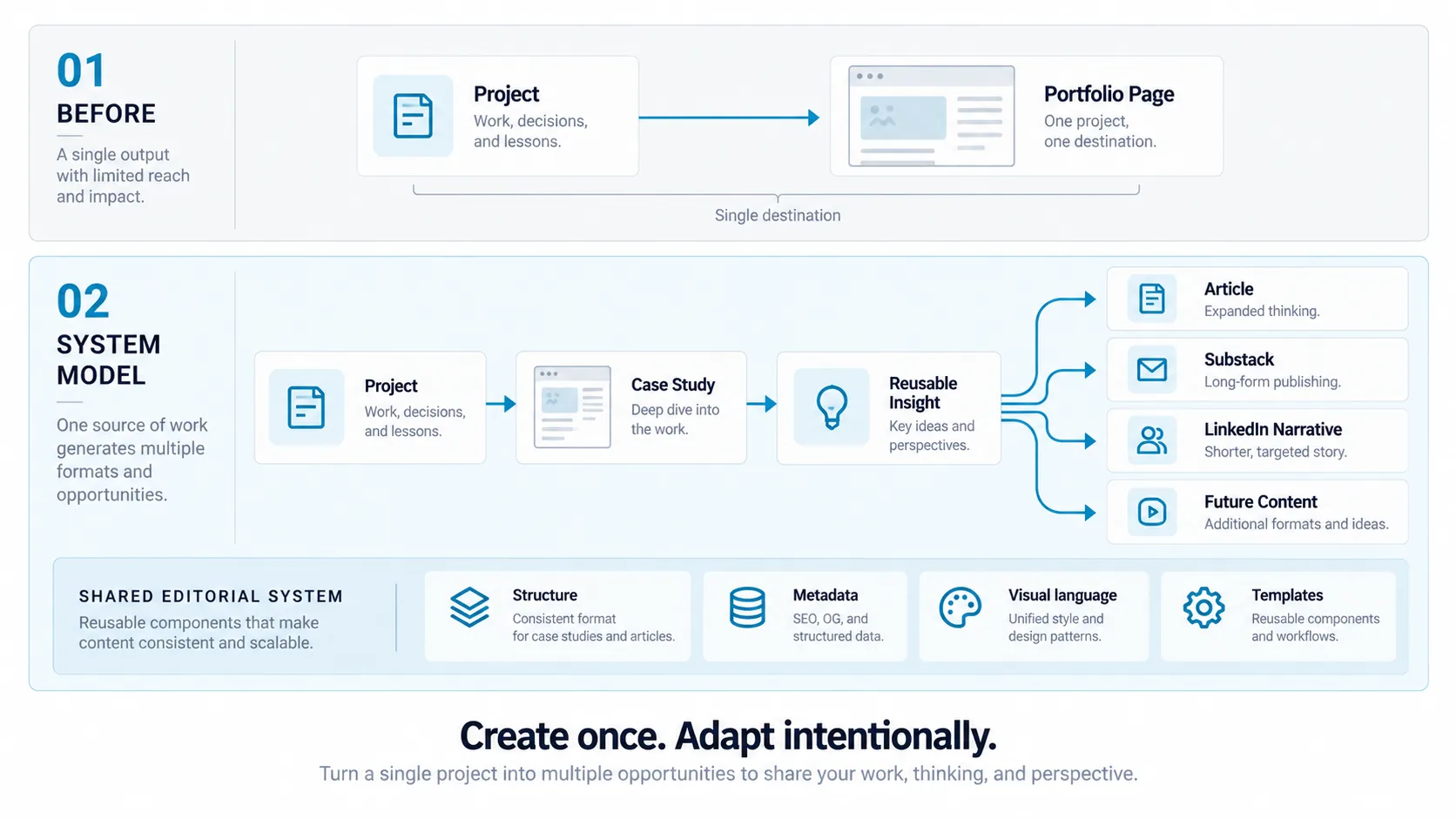
One source of knowledge could now support multiple forms of communication without requiring the underlying story to be recreated every time.
Key decisions
Decision 01
Make the portfolio the canonical source
The website remains the deepest representation of the work: context, challenges, decisions, evidence, and outcomes.
Other channels create discovery paths back toward that source rather than replacing it.
Distribution channels can change. The portfolio remains durable.
Decision 02
Separate proof from perspective
Case studies and articles perform different jobs.
Case studies demonstrate how I approached a real problem. Articles extract broader ideas from that experience and turn them into reusable professional perspectives.
A design-system initiative, for example, can provide evidence for articles about governance, AI-readable systems, design-to-code workflows, or organizational scale.
Case studies show what I have done. Articles show how I think.
Decision 03
Give every channel a role
I avoided publishing identical content everywhere.
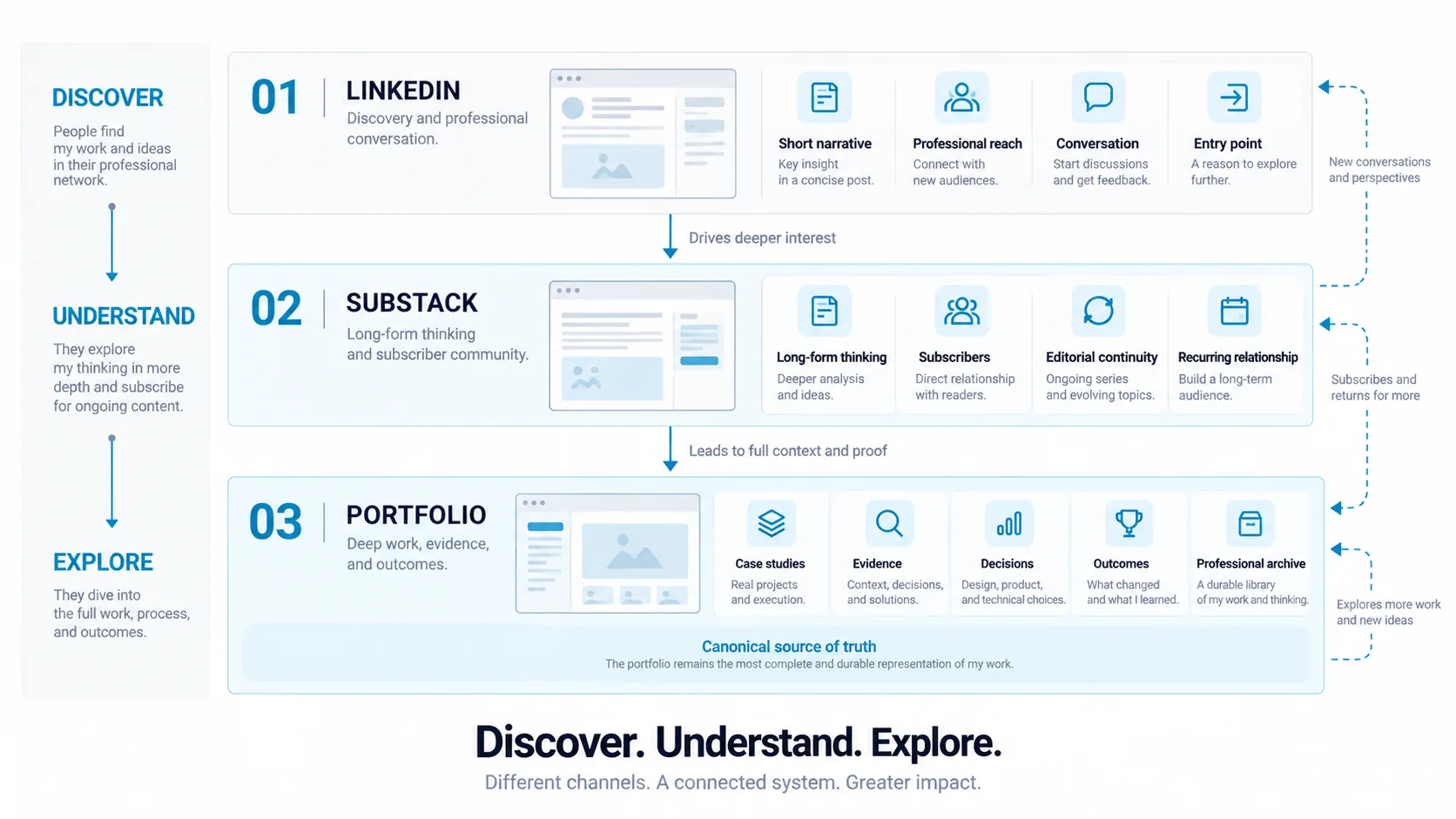
The portfolio provides depth. Substack provides long-form editorial continuity. LinkedIn compresses an idea into an accessible professional narrative that creates discovery.
The communication model becomes:
Channels become more useful when each performs a specific function.
Decision 04
Build publishing into the system
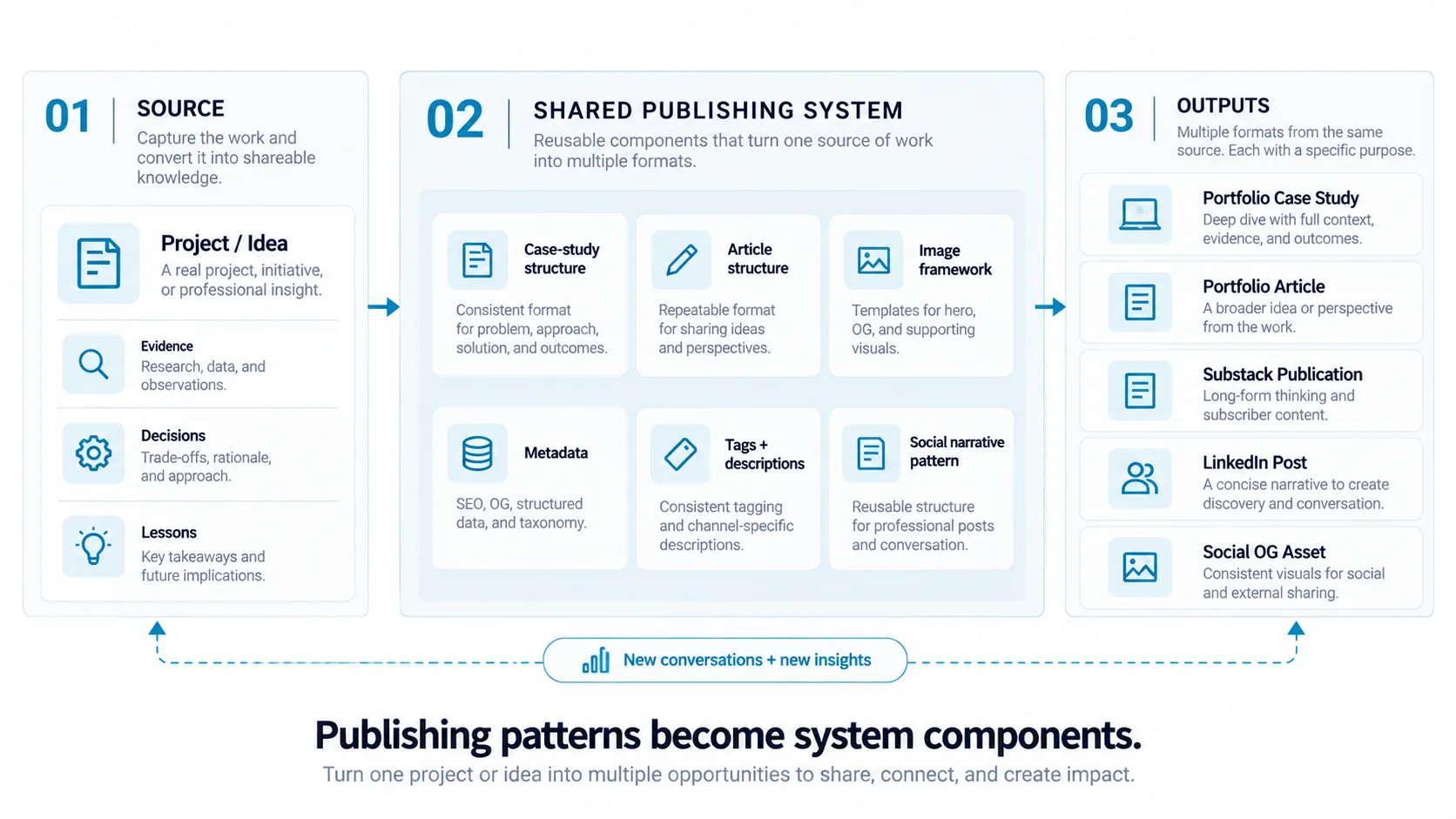
I created reusable structures for case-study sections, article graphics, Open Graph images, captions, metadata, descriptions, tags, and social posts.
Publishing became part of the design system rather than an activity performed after the work was complete.
Content becomes scalable when publishing patterns become reusable components.
The solution
The final portfolio operates as a connected content ecosystem.
The website contains two primary forms: case studies and writing.
Case studies communicate execution, leadership, decisions, and outcomes. Articles convert those experiences into reusable thinking about UX leadership, AI, design systems, accessibility, and product development.
Substack extends that thinking into a subscriber-based channel. LinkedIn becomes the distribution layer, using shorter standalone narratives to introduce an idea and create a path toward deeper content.
The operating loop becomes:
Publishing is no longer separate from the work. It becomes a continuation of it.
Impact
The redesign changed the function of my portfolio.
It is no longer simply a destination waiting to be discovered. It is the foundation of an ongoing professional communication system.
A single project can now produce detailed evidence for evaluators, strategic thinking for peers and leaders, long-form content for subscribers, and concise narratives for professional networks.
More importantly, the system creates continuity between what I do and what I communicate.
The larger shift is from portfolio as archive to portfolio as platform.
The work provides the evidence. The articles extract the thinking. Substack creates continuity. LinkedIn creates discovery. The portfolio connects them into one coherent professional narrative.